Showing posts with label China. Show all posts

1/23/17

1,700 Year Old Silk Road Cemetery, China


A cemetery dating back around 1,700 years has been discovered in Kucha, a city in China. 

The city played an important role along the Silk Road trade routes that connected China to the Roman Empire. Archaeologists have uncovered 10 tombs in the cemetery, seven of which are large structures made with bricks. This image shows a up-close view of a heavenly deer from the screen wall. The carved bricks were originally painted, but these decorations have since peeled off 


Archaeologists uncovered 10 tombs in the cemetery, seven of which are large structures made with bricks. This image shows part of the cemetery facing north.


The cemetery was first found in July 2007 and was excavated by the Xinjiang Institute of Cultural Relics and Archaeology, with assistance from local authorities.


1/21/17

Longmen Grottoes, China

photo credit: Kevin Poh


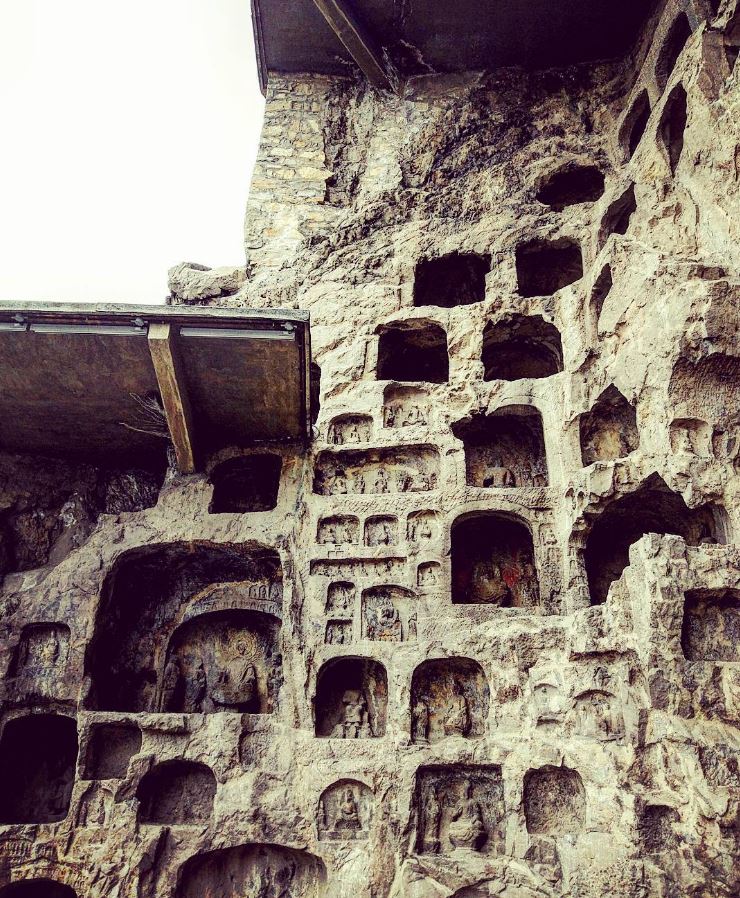
The Longmen Grottoes  or Longmen Caves are one of the finest examples of Chinese Buddhist art. Housing tens of thousands of statues of Buddha and his disciples, they are located 12 kilometres (7.5 mi) south of present-day Luòyáng in Hénán province, China. The images, many once painted, were carved as outside rock reliefs and inside artificial caves excavated from the limestone cliffs of the Xiangshan and Longmenshan mountains, running east and west. The Yi River flows northward between them and the area used to be called Yique. The alternative name of "Dragon's Gate Grottoes" derives from the resemblance of the two hills that check the flow of the Yi River to the typical "Chinese gate towers" that once marked the entrance to Luoyang from the south.


There are as many as 100,000 statues within the 2,345 caves, ranging from an 1 inch (25 mm) to 57 feet (17 m) in height. The area also contains nearly 2,500 stelae and inscriptions, whence the name “Forest of Ancient Stelae", as well as over sixty Buddhist pagodas. Situated in a scenic natural environment, the caves were dug from a 1 kilometre (0.62 mi) stretch of cliff running along both banks of the river. 30% date from the Northern Wei Dynasty and 60% from the Tang, caves from other periods accounting for less than 10% of the total.Starting with the Northern Wei Dynasty in 493 AD, patrons and donors included emperors, Wu Zetian of the Second Zhou Dynasty, members of the royal family, other rich families, generals, and religious groups.

photo credit: Anagoria

photo credit: kevinmcgill

photo credit: Charlie

In 2000 the site was inscribed upon the UNESCO World Heritage List as “an outstanding manifestation of human artistic creativity,” for its perfection of an art form, and for its encapsulation of the cultural sophistication of Tang China.


This complex is one of the three notable grottoes in China. The other two grottoes are the Yungang Caves near Datong in Shanxi Province, and the Mogao Caves near Dunhuang in Gansu Province in west China. The valley formed by the Yi River enclosed by two hills ranges of Xiangshan (to the east) and Longmenshan (to the west) hills have steep slopes on the western and eastern slopes along the river. Yi is a north flowing tributary of the Luo River. The grottoes are formed in 1 km of the stretch of this river and were carved on both banks, in limestone formations creating the Longmen Caves. Most of the work was done on the western bank, while the eastern bank caves, of smaller numbers, served as residences for the large groups of monks.

photo credit: Anagoria

Within the approximately 1,400 caves, there are 100,000 statues, some of which are only 1 inch (25 mm) high,while the largest Buddha statue is 57 feet (17 m) in height.There are also approximately 2500 stelae and 60 pagodas. The grottoes are located on both sides of the Yi River. Fifty large and medium-sized caves are seen on the west hill cliffs which are credited to the Northern, Sui, and Tang Dynasties, while the caves on the east hill were carved entirely during the Tang Dynasty.The plethora of caves, sculptures and pagodas in Longmen Grottoes depict a definite "progression in style" with the early caves being simple and well shaped with carvings of statues of Buddha and religious people. The change of style is more distinct in the Tang Dynastic periods which are “more complex and incorporate women and court figures as well”. The caves have been numbered sequentially from north to south along the west bank of the Yi River. Entry to the caves is from the northern end.

photo credit: Anagoria


photo credit: Anagoria


photo credit: severin.stalder


photo credit: G41rn8


photo credit: 


photo credit: 


photo credit: 

12/8/16

Yangshan – Surreal Chinese Megalith


Yangshan in China can only be described as a megalithic mystery. There is nothing else like this in China it’s a total one off. Just look at this thing! It obviously had a working function. It was supposedly built in the 1400’s as a tomb but personally I suspect it’s much older. Although unique in China this megalith is reminiscent of the structures in Peru. 

One stone is 17meters high, with a width of 29.5meters and a thickness of 12 meters, totally 16250 tons heavy. Another one is 51meters high, 14.2 wide, 4.5meters thick and 8799 tons heavy. The third stone is 10 meters high, 22meters wide, 10.3meters thick and 6118 tons heavy.


If we combine the three stones together, they will form a huge complete stele, which is 78meters, as high as a building of 28 storeys. And the weight of the huge stele is 31.167million kilograms, a rare stele and a marvelous spectacle in the world.


11/9/16

Blue Moon Valley, China

Blue Moon Valley gets the water out of the melting snow that runs from the mountains and forms four lakes and a few waterfalls.

The head of the valley is one of the main tourist sites and has natural white water terraces. the water often  appear as an amazing turquoise-blue.


MAKING MONEY ONLINE WAS NEVER SO EASY !!!


10/29/16

Enigmatic Pattern Discovered Over Chinese Mountains

About ten years ago, a local man named Gao Shuxian from Chengdu, Sichuan Province, ventured up a newly constructed signal tower on top of a mountain peak in the Matou village in order to have a better view over the astonishing forest and nearby surroundings.He was really surprised to see that, when viewed from above, a decent part of the forest to the north transformed into something mysterious.At first, he couldn’t exactly explain what he saw because the signal tower did not offer him enough height in order to have a clear view over the entire anomaly.


"When I was standing on the signal tower 10 years ago, I saw that some trees in the cedar woods were somewhat different from the other trees. They were growing in lined radial patterns. I thought it was amazing, but I was unable to get the whole picture because the signal tower I was standing on was not high enough."


Bearing the strange sight in mind for over a decade, Gao Shuxian decided to have another look, now that the new technology allows people to check different areas of our planet from satellite.Using the online satellite maps, he checked that particular area of the mountain and saw the mysterious pattern the trees formed, now being able to have a better and ampler view.He distinguished three giant symbols formed by the trees that if united resembled to Chinese character “犇” which means “run fast”.


The puzzling design of the forest spreads from northwest to southwest over the mountain range, covering over 1,200 acres, with the entire pattern being about 0,6 miles long and 0,3 miles wide.


We can see clearly that the trees forming the arrangement have a different color as well as different heights.


MAKING MONEY ONLINE WAS NEVER SO EASY !!!