Petit Mont is neolithic site 6,600 years old.The entire cairn measures 50 meters east-west and 53 meters north-south, with an estimated volume of stones of 10,000 cubic meters. Petit Mont chambered tomb we see today is the result of at least three different stages of construction.
The first cairn was constructed on a low mound thought to be about 6,600 years old. This early cairn, 6,500 years old, was a simple trapezoidal mound of small rocks that measured about 30 by 20 metres. The cairn was extended between 6,000 and 5,500 years ago with a simple passage and single chamber. Six of the eight megaliths making up the chamber and three of those making up the passage are decorated. Sometime between 4,700 and 4,500 years ago the cairn was expanded, which destroyed the earlier chamber. Two new single chambered passages were created; the later chambers have more engravings in them than the earlier one.
The entrance to the first passage is on the right, the ‘hole’ in the middle of the cairn is one of the entrance to one of the later passages destroyed by the construction of the bunker.
During the second World War, in 1943 to be precise, a bunker or blockhouse was built into the cairn. The bunker was part of the extensive system of fortifications that formed the Atlantic Wall, running from Scandinavia in the north and along the north-western coast of continental Europe. Construction of the bunker destroyed the two older chambers, but facilitated the excavation of the earlier passage and its chamber.
The Château de Montségur is probably the best known of all Cathar Castles. It is famous as the last Cathar stronghold, which fell after a 10 month siege in 1244. A field below the hilltop castle is reputed to be the site where over 200 Cathars were burned alive, having refused to renounce their faith.
A building on this site sheltered a community of Cathar women at the end of the twelfth century. Early in the thirteenth, Raymond de Pereille the co-seigneur and Chatelain, was asked to make it defensible, anticipating the problems to come.
It`s hard to say when it was built for the first time.In about 1204, Raymond de Péreille, one of the two lords of Montségur,decided to rebuild the castle that had been in ruins for 40 years or more.Refortified, the castle became a center of Cathar activities, and home to Guilhabert de Castres, a Cathar theologian.In 1233 the site became "the seat and head" of the Cathars.It has been estimated that the fortified site housed about 500 people when in 1241, Raymond VII besieged Montsegur without success.
In 1242 Hugues de Arcis led the military command of about 10,000 royal troops against the castle that was held by about 100 fighters and was home to 211 Perfects (who were pacifists and did not fight) and civilian refugees.The siege lasted nine months, until in March 1244, the castle finally surrendered. Approximately 220 Cathars were burned en masse in a bonfire at the foot of the pog when they refused to renounce their faith. Some 25 actually took the ultimate Cathar vow of consolamentum perfecti in the two weeks before the final surrender. Those who renounced the Cathar faith were allowed to leave and the castle itself was destroyed.
In the days prior to the fall of the fortress, several Cathars allegedly slipped through the besiegers' lines carrying away a mysterious "treasure" with them. The siege itself was an epic event of heroism and zealotry, akin to that of Masada, with the demise of the Cathars symbolized by the fall of the mountain-top fortress (although isolated Cathar cells persisted into the 1320s in southern France and northern Italy).
The present fortress ruin at Montségur is not from the Cathar era. The original Cathar fortress of Montségur was entirely pulled down by the victorious royal forces after its capture in 1244. It was gradually rebuilt and upgraded over the next three centuries by royal forces. The current ruin so dramatically occupying the site, and featured in illustrations, is referred to by French archeologists as "Montsegur III" and is typical of post-medieval royal French defensive architecture of the 17th century. It is not "Montsegur II," the structure in which the Cathars lived and were besieged and of which few traces remain today.
Montségur's solar alignment characteristics, visible on the morning of the summer solstice in particular, are part of what set this castle apart as an architectural wonder. This often mentioned solar phenomenon, occurring in an alignment of two windows in the fortress wall, has been observed by hundreds of students, astronomers, spiritual pilgrims and locals alike who come to the chateau specifically to view it every year and has been recorded.
The earliest signs of human settlement in the area date back to the stone age, around 80,000 years ago. Evidence of Roman occupation such as Roman currency and tools have also been found in and around the site. Its name comes from Latinmons securus, which evolved into mont ségur in Occitan, which means "safe hill". In the Middle Ages the Montsegur region was ruled by the Counts of Toulouse, the Viscounts of Carcassonne and finally the Counts of Foix. Little is known about the fortification until the time of the Albigensian Crusade.
The Tour Percée double arch, also named the Tour Isabelle arch, is a double natural arch, located in the Parc Naturel Régional de la Chartreuse, Chartreuse Mountains, France. Its span is 32 metres (105 ft), which makes it the biggest natural arch in the Alps. It remained unknown for probably everybody, until its discovery in May 2005, when Pascal Sombardier, who was trekking to write its book Chartreuse inédite : Itinéraires insolites, dealing with lost places of the range, discovered it fortuitously. Its pictures illustrated the front cover of his book, published in 2006 : this double arch became then the symbol of the hidden treasures of the Chartreuse Mountains. Located in a very remote area, with a difficult and dangerous access, very few guide books, even the most recent ones, mention its existence.
Extremely large (780 tonnes) and celebrated balanced rock and similar structures, in an area abounding with many odd rock shapes to the east of Castres. Some of these have been revered since history began.
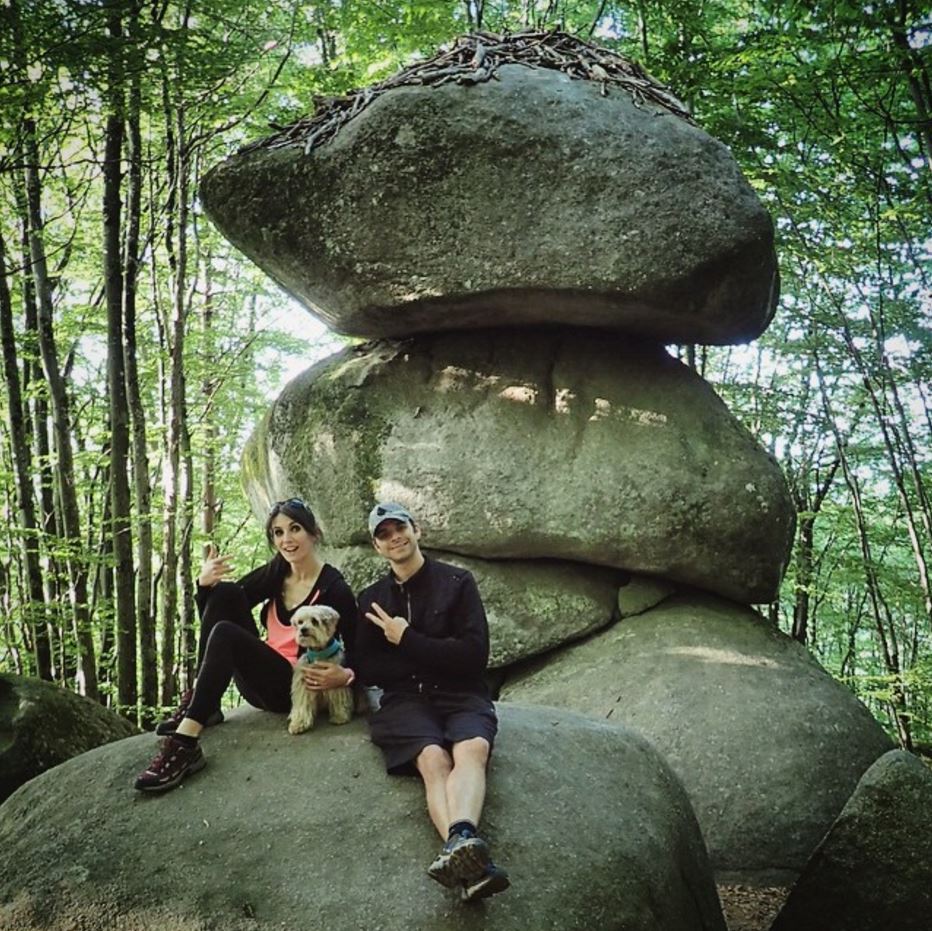
Not a megalithic or ancient,but to much cute photo from same location to leave out