Showing posts with label Java. Show all posts

1/6/17

Magical Candi Plaosan Lor temple, Java, Indonesia

photo credit: rifandy.p


Candi Plaosan, also known as the 'Plaosan Complex', is one of the Buddhist temples located in Bugisan village, Prambanan district, Klaten Regency, Central Java, Indonesia, about a kilometer to the northwest of the renowned Hindu Prambanan Temple.Candi Plaosan covers an area of 2,000 square meters with an elevation of 148 meters above sea level. The Dengok River is located nearby, about 200 meters away. Candi Plaosan is surrounded by paddy fields along with vegetation such as banana and corn.


photo credit: rifandy.p

photo credit: rifandy.p

Plaosan temple was built in the mid 9th century by Sri Kahulunnan or Pramodhawardhani, the daughter of Samaratungga, descendent of Sailendra Dynasty, and who was married to Rakai Pikatan in the Hindu tradition. The Plaosan complex is an ensemble of two Buddhist temples, Plaosan Lor and Plaosan Kidul. The temples are separated by a road; Plaosan Lor is located in the North and Plaosan Kidul in the South. Plaosan Lor consists of two main temples and an open area known as a mandapa. Both temples have an entrance, a gate, and the guardian statue known as Dwarapala. Plaosan Lor and Plaosan Kidul are considered to originally be one complex.

photo credit: bangandyfoto

The Plaosan temple complex is made up of 174 small buildings, 116 are stupas and 58 are shrines. Many of the buildings have inscriptions. Two of these inscriptions denote the temple as a gift of sanctuary by Rakai Pikatan. The dates of the inscriptions are between 825-850 AD. Although similar to the Prambanan 856 AD date, the complexes are not related. A new building technique distinguishes Prambanan from Plaosan temples.

photo credit: asrinindi

The main temples at Plaosan are made up of an upper and lower level, separated in three rooms. In the lower level, multiple statues resided. Today, only two statues of Bodhisattva seated on each sides of each rooms, flanked an empty pedestal. However, as the position of the false windows dictate, there was only one statue rested on the bottom basal level on central pedestal. This statue today is missing, it was probably some bronze statues depicting Buddha with two stone Bodhisattva statues flanked it. Historians suggests that a main temple once contains nine statues, six stone Bodhisattvas, and three bronze Buddhas (now missing). This means there was 18 statues resided in the twin main temples.
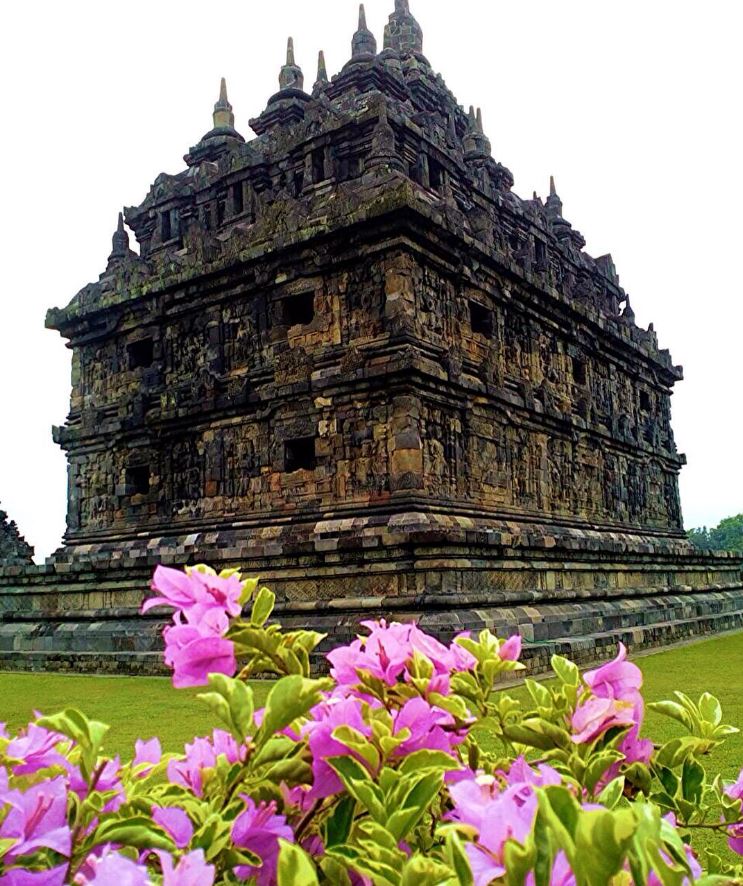
photo credit: desimartianaputri

photo credit: jejak.kecil

photo credit: fatikusuma

photo credit: plunq_info

photo credit: Gunkarta

On the upper walls in each rooms, there are the traces of stones indentions that once supported wooden beams and wooden floors, creating upper rooms. There is also traces of stones as the base of wooden stairs.
Rows of exquisite carvings of Bodhisattvas divinities are found adorning the outer walls, with the majority of them being male. Smaller and less occurring carvings by the windows represent female figures.
One exceptional example is carved on inner wall of the room depicting a representation of a Khmer prince which is identified by his crown.

photo credit: Gunawan Kartapranata

photo credit: Nomo


12/4/16

Stunning Electric-Blue Flames Erupt From Volcanoes

Sulfur combusts on contact with air to create stunning blue lava-like rivers of light in the Kawah Ijen crater on the island of Java.


This blue glow—unusual for a volcano—isn't, of course, lava, as unfortunately can be read on many websites.The glow is actually the light from the combustion of sulfuric gases.Those gases emerge from cracks in the volcano at high pressure and temperature—up to 1,112°F (600°C). When they come in contact with the air, they ignite, sending flames up to 16 feet (5 meters) high.Some of the gases condense into liquid sulfur,which continues to burn as it flows down the slopes giving the feeling of lava flowing. Forest fires in Yellowstone National Park have caused similar "rivers," as heat from the blazes melted the sulfur around hydrothermal vents.Blue volcanic fire was described in antiquity in Italy on the south slope of Mount Vesuvius and on the island of Vulcano.There was no use of any filters to capture this images of the blue fire. The burning happens day and night, but it's visible only in darkness.


Kawah Ijen Crater Lake is green because of the hydrochloric acid in the water.
 
Kawah Ijen Crater Lake, at the top of the volcano, is the world's largest such body of water filled with hydrochloric acid. In fact, it's the acid that makes the water green.
The volcano emitted hydrogen chloride gas, which reacted with the water and formed a highly condensed hydrochloric acid with a pH of almost 0.

In the Kawah Ijen crater, sulfuric gases escaping from cracks ignite as they come in contact with the air.


A river of sulfur flows near Kawah Ijen's acid lake.


When Grunewald photographs Kawah Ijen, he wears a gas mask as protection against toxic gases, including sulfur dioxide. "It is impossible to stay a long time close to a dense acid gas without a mask," he said.
Pallister described the miners' daily routine as "tough duty." He has seen many of them using only wet cloths as gas masks.
Some of the miners do have gas masks that visitors have given them, said Grunewald, but they "have no money and no opportunity to change the filters."
"I feel bad for these miners," Werner said. When she and her colleagues work in Indonesia, "we usually bring gas masks and leave them there with the people we work with, because sometimes they don't know that what they are breathing is harmful."

In Ethiopia's Danakil Depression, the sulfur dust in the soil of a hydrothermal vent ignites to form blue flames.

Grunewald has also documented the blue glow on the Dallol volcano in the Danakil Depression, in the Afar region of Ethiopia near the borders of Eritrea and Djibouti.
The heat of magma sometimes ignites the sulfur dust in the soil, forming flames of electric blue.
"It is very rare to see that," said Grunewald. "The powder of sulfur could burn for a few days."
The depression is geologically active, with hydrothermal vents and sulfur springs, some of which are tourist attractions.
The Afar region is famous for having the world's highest average temperature of 93°F (34°C), thanks in part to the volcanic activity.


Source:
http://news.nationalgeographic.com/