Showing posts with label Medieval. Show all posts

1/22/17

Gravensteen castle, Ghent, Belgium


The Gravensteen is a castle in Ghent originating from the Middle Ages. The name means "castle of the counts" in Dutch.The Gravensteen is situated at an altitude of 9 meters.

The present castle was built in 1180 by count Philip of Alsace  and was modeled after the crusaders castles that Philip of Alsace encountered while he participated in the second crusade. Before its construction, there stood a wooden castle on the same location, presumably built in the ninth century. The castle served as the seat of the Counts of Flanders until they abandoned it in the 14th century. The castle was then used as a courthouse, a prison and eventually decayed. Houses were built against the walls and even on the courtyard and the stones of the walls were used to erect other buildings. At one time it even served as a factory. At the end of the 19th century, the castle was scheduled to be demolished.


1/10/17

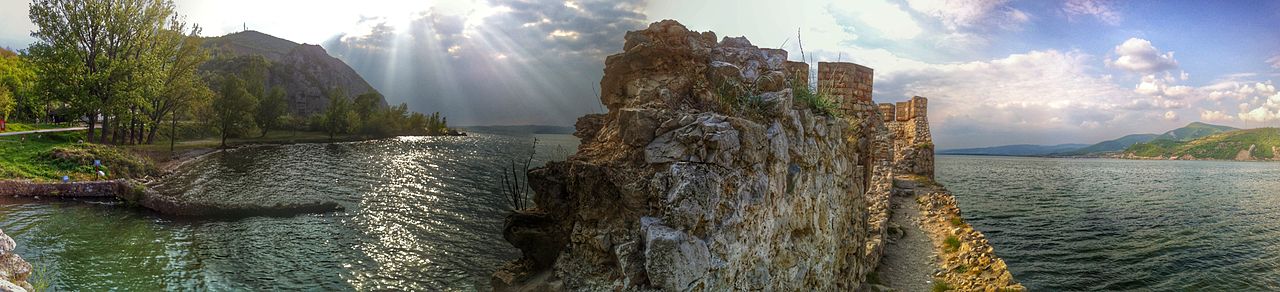
Golubac fortress, Serbia


The Golubac Fortress was a medieval fortified town on the south side of the Danube River, 4 km downstream from the modern-day town of Golubac, Serbia. The fortress, which was most likely built during the 14th century, is split into three compounds which were built in stages. It has ten towers, most of which started square, and several of which received many-sided reinforcements with the advent of firearms.
Golubac Fortress has had a tumultuous history. Prior to its construction it was the site of a Roman settlement. During the Middle Ages, it became the object of many battles, especially between the Ottoman Empire and the Kingdom of Hungary. It changed hands repeatedly, passing between Turks, Bulgarians, Hungarians, Serbs, and Austrians, until 1867, when it was turned over to the Serbian Knez, Mihailo Obrenović III. Now, it is a popular tourist attraction in the region and a sightseeing point on Danube boat tours.

photo credit: danubetravel


photo credit: Mefisto822


photo credit: vanicphotography

photo credit: Mefisto822

photo credit: Mefisto822

photo credit: NeroN_BG

photo credit: NeroN_BG

photo credit: ZoranCvetkovic

photo credit: Mefisto822

photo credit: Jsphotomorgana

photo credit: Mefisto822


12/18/16

Medieval fortress Maglič, Serbia


Maglič is a 13th-century fortress about 20 km south of Kraljevo, Serbia. The castle is located atop a hill around which the Ibar river makes a curve, about 100 m above the river. The fortress protected the only road that connected the Great Morava Valley and Kosovo polje. Its name means The Foggy One from the Serbian word "Magla" (Магла), meaning fog.


Maglič was probably built in the first half of the 13th century by Stephen the First Crowned or his son Urosh I. During the Serbian empire it was the seat of Archbishop Danilo II, who wrote his famous hagiographies and regiographies in Maglič.


After capturing Smederevo on June 20, 1459, the Ottoman Empire occupied Maglič and held it until its recapture by Serbs during the Great Turkish War. After the defeat of the Serbian uprising the Ottoman Turks retook the fortress, abandoning it soon after.


During the Second Serbian Uprising, Voivod Radoslav Jelečanin ambushed a group of Turkish soldiers at Maglič and halted their advance from Novi Pazar.


The fortress consist of seven towers and one dungeon tower connected with walls. The towers are typical for a medieval fortress in the Balkan peninsula with three solid sides and wooden fences on inner side. Maglič has one gate placed in the north, and one small sally port in one of the towers in the southeast part. Inside the fortress are remains of a palace, barracks, and a church of Saint George. There is also a large reservoir for water and a well. In the southern part of the fortress, three towers are placed next to each other to give better protection from attacks.